




President Donald Trump on Sunday said he told Ukrainian President Volodymyr Zelenskyy to stop strikes on Russian refineries, claiming they are “causing a shortage of diesel.”
“Mr. Zelensky has to do one thing. He has to stop knocking out diesel fuel in Russia,” Trump said to reporters. “…We spoke to Mr. Zelenskyy about it. There are plenty of other targets. Don’t hit diesel fuel.”
Trump added that the diesel shortage “isn’t done by the Middle East.”
“This is done by what’s happening with Russia and Ukraine,” Trump said.

Download the Straight Arrow app today to get the stories that matter free from manipulation, bias or agenda.™
Point phone camera here
While Ukraine has been attacking Russia’s oil and gas industry, leading the latter to ban diesel exports until the end of September, the U.S. war against Iran has also affected the diesel supply and prices. Renewed conflict in Yemen has also raised the risk premium on global oil flows.
On Friday, oil prices were at over $100 a barrel — Brent crude oil futures were $104.61 a barrel and U.S. West Texas Intermediate was $100.05.
Diesel prices this past week set an all-time high of $6 per gallon on average across the U.S. In California, some stations even set the sticker price for diesel at $9.99 — some to indicate that they were out of the fuel.
Net exports of diesel/gasoil from the Gulf countries averaged 390 kb/d in August as the Strait of Hormuz stays restricted amid the Iran conflict, according to the International Energy Agency. That’s just over a quarter of what exports were before the war.
“Disruptions to Russia’s refining system and a near-halt to product exports following intensified Ukrainian attacks have compounded these losses,” the IEA said. “Combined, net exports of diesel/gasoil exports from the Gulf and Russia in August were 1.6 mb/d lower than in February, when they accounted for almost 45% of global seaborne trade.”
Because of the U.S.-Iran war and attacks in the Gulf and the Red Sea’s Bab el-Mandeb choke point, the IEA cut its supply and demand projections for the rest of 2026.
“With buffers shrinking and the global refining system stretched to the limit, the need for progress in resolving the conflict in the Middle East — and the Russia-Ukraine war, which is now in its fifth year — is greater than ever to avoid further market tightening and demand destruction,” the IEA said.
Russian drone strikes train on Ukraine-Poland border
A Russian drone struck a train at the Ukraine-Poland border on Sunday, shortly after a different train carrying several European officials, including former United Kingdom Prime Minister Boris Johnson and former Swedish Prime Minister Carl Bildt, passed by, Ukrainian Railways (Ukrzaliznytsia) said on Telegram.
A dispatcher from the Central Monitoring Group detected the drone, and a signal to evacuate the train was issued 15 minutes before it landed. There have been no reports of casualties.
“It is highly likely that the Russian drone’s intended target was actually the diplomatic train, which had departed the station earlier than scheduled due to real-time timetable adjustments necessitated by the constant threat of Russian strikes,” Ukrzaliznytsia said, adding that it “continuously adjusts train schedules based on which routes are available and which are blocked due to attacks.”
Another train carrying former CIA Director David Petraeus was still at Yahodyn station when the attack happened, Ukrzaliznytsia said.
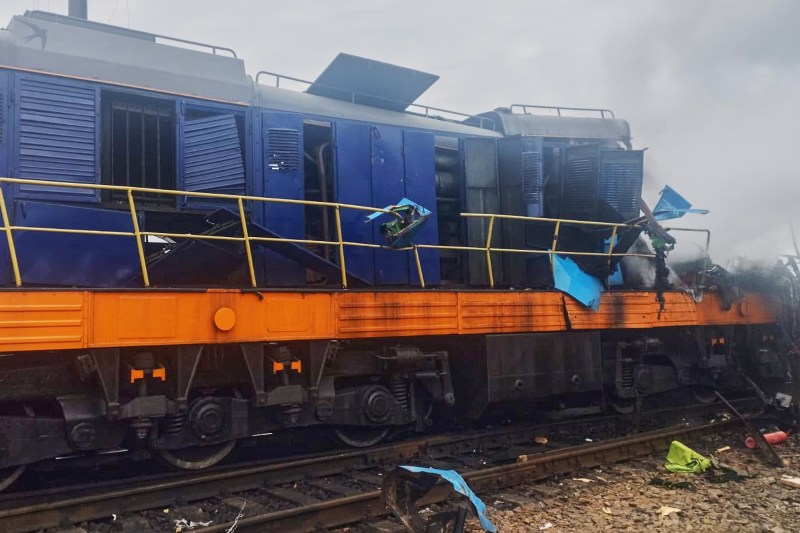
Ukrainian Foreign Minister Andrii Sybiha condemned “Russia’s barbaric strikes.”
“This is Putin’s terror “knocking” directly on the doors of the [European Union] and NATO,” he said. “Act now: throw the full weight of your sanctions at [Russian President Vladimir] Putin’s aggressive regime.”
Johnson said the strike is “the kind of random and senseless attack Ukrainians are enduring every day — even on civilian railways.”
“I don’t know what warped logic drove Putin to blow up a stationary Ukrainian locomotive on the Polish border this morning,” he said.
Bildt posted a video of the attack on X and said “No one was hurt.”
“Very good safety system,” he said. “Our train just had an evacuation warning but could proceed to Dorohusk.”
A gas station was also damaged in the drone strike, Ukrainian President Volodymyr Zelenskyy said.
Along with Ukrzaliznytsia, energy facilities, businesses, and ordinary residential buildings were attacked Saturday night and Sunday morning, Zelenskyy said.
“Odesa was attacked with missiles and drones. Recovery efforts are ongoing in many western regions following the overnight strikes,” he said. “It is precisely to prevent these strikes from spreading further into Europe that Ukrainian men and women fight every day, give their lives, and do not allow the aggression to expand.”
At least nine people were hurt in the overnight attack on Odesa, Serhii Lysak, of the city’s military administration, said, according to The Associated Press. A separate Russian drone attack hit a residential high-rise in Odesa on Saturday, the AP reported. Two people were killed and another 26 wounded.
Ukrainian forces targeted oil refineries in Russia’s Krasnodar Krai and the Republic of Tatarstan, the Kyiv Independent reported Sunday, with fires breaking out at both facilities. Two people were killed in Tatarstan, and 12 were injured, regional authorities said.
Two Russian civilians in Nizhnekamsk died when a drone slammed into a tree near their car, the office of regional head Rustam Minnikhanov said.
