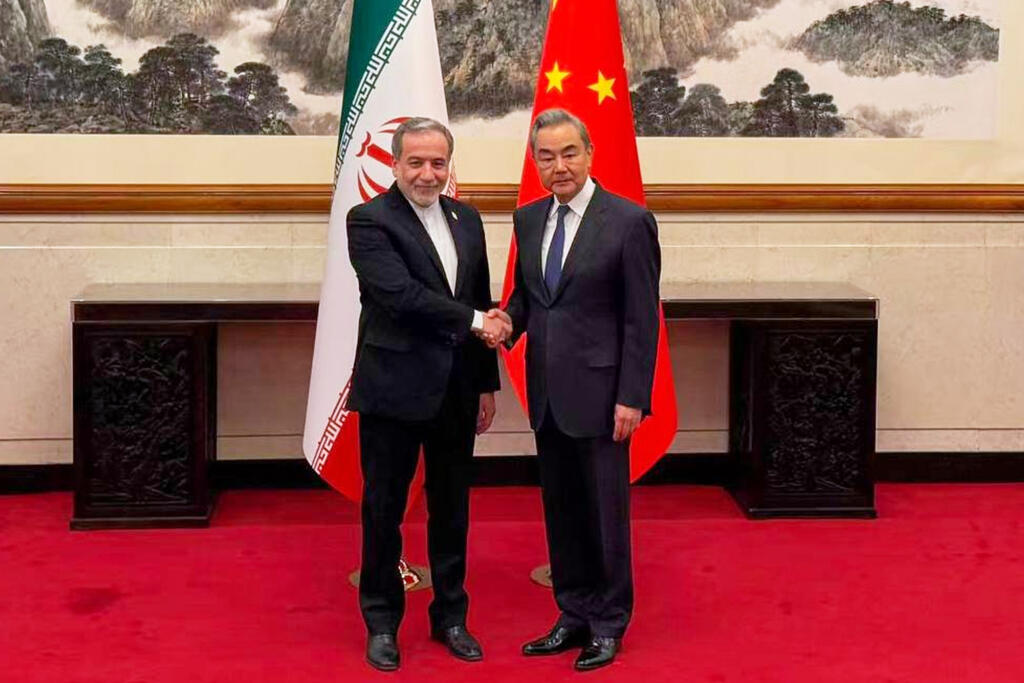



US President Donald Trump has welcomed Chinese President Xi Jinping to Washington for a high-stakes state visit, rolling out the red carpet as the two leaders seek to preserve a fragile truce while confronting tensions over trade, Taiwan and Iran. With US midterm elections approaching and Republicans at risk of losing control of Congress, Trump also has a domestic political stake in making the summit a success.
Issued on: Modified:
5 min Reading time
Advertising
Trump took the unusual step of personally greeting Xi and his wife, Peng Liyuan, at Joint Base Andrews outside Washington on Wednesday, where they were met with a red carpet, military honours and a flyover by B-1 bombers.
The visit has already produced one concrete result. Washington announced a two-month extension of a trade truce with Beijing that had been due to expire in November, giving the two sides more time to negotiate over a relationship repeatedly shaken by tariffs and other trade restrictions.
But Thursday’s talks reach well beyond trade. China’s relations with Iran, tensions over Taiwan and the wider strategic rivalry between Washington and Beijing leave plenty of room for disagreement – while both leaders have their own political reasons for wanting the visit to be seen as a success.
Michael Dillon, a history professor affiliated with the Lau China Institute of London’s King’s College, spoke to RFI about the political calculations behind the meeting and Trump’s approach to China – as well as Xi’s prospects of remaining in power beyond 2027.
RFI: What do you think President Trump will get out of this meeting with Xi Jinping?
Michael Dillon: He has the midterm elections, which are, at least in theory, more transparent than any political manoeuvrings within [China’s leadership compound] Zhongnanhai in Beijing. Trump is beginning to realise that he’s really in danger of losing the House and possibly even the Senate.
So appearing at a full state visit could increase his prestige. But all I can see are advantages in appearance protocol at the moment rather than detail – although the detailed negotiations have been going on for some time, notably between Scott Bessent, the American trade secretary, and Hua Lixiang, his Chinese counterpart.
Trump victory in surprise landslide vote leaves Philadelphia stunned
“The track record of US-China relations is not good.”
Remarks by Michael Dillon, Lau China Institute, King’s College, London.
RFI: And what’s in it for Xi?
MD: In 2027 he is going to have to either step down or have his current term of office extended. All the markings at the moment suggest that that’s going to carry on. It won’t do him any harm within the Communist Party to have been out to see Trump, and to be seen as strong against rather a weakened Trump.
But the track record of US-China relations is not good. And the worrying factor for Xi must be the fact that there have been so many policy changes that he can’t be sure what Trump is going to say.
RFI: China has longstanding relations with both Venezuela and Iran. The United States has taken military and economic action against both countries, including measures affecting their oil industries, while disruptions around the Strait of Hormuz and the Bab-el-Mandab have affected regional energy flows. How might these developments affect China’s interests and its relations with Washington?
MD: This is a major problem for China. The Strait of Hormuz is the way that Middle Eastern oil gets out into the Indian Ocean and around to China. China is, for its fantastic development speed, dependent on foreign energy. It wants to see an end to the war between the US and Iran to stabilise the situation generally in the Middle East, which has now become much more complicated with the Houthis upping their attacks on Saudi Arabia.
Xi will want to use as many diplomatic levers as he has to try and persuade Trump to get out of Iran. It’s very difficult to say if he will succeed. Trump seems to have got himself into a position where everybody around him knows he’s in the wrong, and yet he is not able to get out of it.

RFI: Taiwan has been a longstanding point of tension between China and the United States, since the two countries established diplomatic relations in 1979. While Beijing considers Taiwan part of China, Washington maintains unofficial relations with Taiwan and provides it with defensive arms under the Taiwan Relations Act – although the Trump administration recently delayed a reported US$14 billion in arms sales to Taiwan. How might changes in US policy towards Taiwan affect Beijing’s approach to cross-Strait relations and its stated goal of reunification?
MD: He doesn’t want any ongoing negotiations about arms to Taiwan to be on the table while the summit is going ahead, but Trump does not have any sympathy for Taiwanese independence. He’s certainly not part of the large group of Americans who are informed about Asia who are sympathetic to Taiwan independence.
It would be a feather in Xi Jinping’s cap if he could manage to incorporate Taiwan into the mainland. That is highly unlikely. But there could be some deal done which makes it look nearer, in the same way that the takeover of Hong Kong began quite slowly and suddenly changed into something major.

‘I hope France speaks out’ son of jailed Hong Kong media icon tells RFI
RFI: The Trump administration has raised human rights issues in relation to China, including the case of Hong Kong media tycoon Jimmy Lai, while President Trump has also acknowledged Beijing’s concerns about Lai. How would you describe the current role of human rights in US-China relations, and how does it compare with previous US administrations?
MD: Trump’s never had any truck with human rights at all. Trump’s negotiations are transactional. He seemed to be prepared to speak up for Jimmy Lai, presumably because there was something in it for him.
Trump is not doing very [well] at human rights at home at the moment, having just closed down a lot of the news reporting of his own press conferences. I don’t really think he ever considers human rights to be something that matters. He really is out of the run of normal United States presidents on that issue.