




Honor guards from every military branch were lined up, America’s most advanced jets were on display and President Donald Trump and First Lady Melania Trump were there to greet Chinese President Xi Jinping. The scene was similar to when Trump visited Beijing in May, but with one major difference: Trump was actually there to shake the incoming foreign leader’s hand, a courtesy Xi didn’t extend to Trump.
Wednesday’s arrival kicked off a three-day visit that continues today, when Trump and Xi meet for the first time since May to discuss a wide range of topics.

Download the Straight Arrow app today to get the stories that matter free from manipulation, bias or agenda.™
Point phone camera here
Two fights are playing out between the world’s biggest economies right now: a race to build artificial intelligence and a Chinese lock on the rare-earth minerals that power it. Neither is expected to get settled today. Washington and Beijing are already building rival coalitions to control AI’s future, and the rare-earth clock resets to a November deadline regardless of what gets discussed at the White House.
The chip fight
AI models need advanced chips to run, and analysts see chips as the most immediate point of contention at today’s meeting. U.S. companies make the most powerful ones, but the Trump administration has restricted sales of its most advanced chips to China, fearing Beijing could use them to close the gap between the two countries’ AI capabilities.
However, analysts don’t expect meaningful movement on this front.
“I do not expect any movement on the chip controls issue, which [U.S. Trade Representative Jamieson Greer] has clearly indicated was not a subject of discussion for the talks on AI,” Martin Chorzempa, a senior fellow at the Peterson Institute for International Economics, told Straight Arrow.
Nvidia, the leading AI chip manufacturer, projected its share of the Chinese market will shrink to about 8% this year, down from 40% in 2025. Its Chinese rival Huawei has seen its share grow to about 50%, according to Fast Company. Nvidia’s latest earnings report assumes zero China data-center revenue going forward.
The fight isn’t just U.S.-China. Nvidia has pushed the Trump administration to loosen restrictions, but officials haven’t budged. Melanie Hart, senior director of the Atlantic Council’s global China hub, said during a press call earlier this week that China is pushing the U.S. to “embrace” Chinese AI models and drop some control restrictions on chips.
The rare-earth clock
A major deadline is looming over today’s meeting. In October, China announced a sweeping wave of export controls on rare-earth minerals, which are essential to AI chips. The most significant was that any product made anywhere in the world containing even a trace amount of Chinese-origin minerals would need a Chinese export license.
A day before it took effect, the government paused it for a year, until Nov. 10, after Trump met Xi in South Korea a week earlier.
Analysts don’t expect China to budge on the topic at today’s meeting.
“The debate seems to be over the length of the extension,” Chorzempa told Straight Arrow, adding that any real outcome would likely involve specifics on supply for defense buyers. But he said China isn’t likely to give up ground there either.
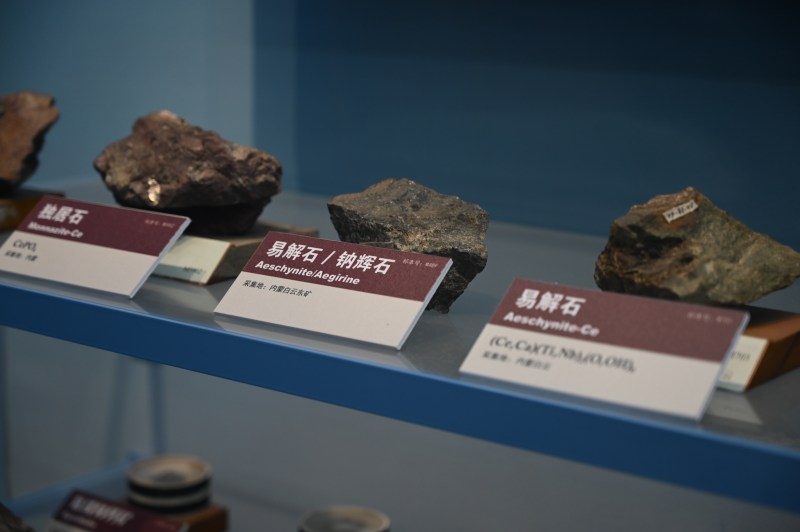
If the pause lapses entirely, it could cause a major global supply chain issue, since China controls over 90% of the world’s processed rare earth minerals.
The U.S. is working to increase domestic production, something Conor Bernstein with the National Mining Association calls critical to reducing reliance on China.
“There’s nothing theoretical about China’s willingness or ability to use its mineral supply chain dominance as a weapon,” he told Straight Arrow. “China has both a significant headstart and isn’t going to cede leverage without a fight.”
Is there actually an AI arms race?
Comparisons to the Cold War’s nuclear arms race don’t quite hold up, Hart said. Once both superpowers had enough weapons to deter each other, adding more only increased the risk. That’s why both sides eventually agreed to arms-control treaties.
AI doesn’t work that way, Hart said, because faster AI development has value beyond the U.S.-China rivalry and neither country has a reason to hold back.
“Because neither side can verify [the other side complying], there’s really no incentive structure for anyone to hobble their own development within the US-China AI race,” she said. “That’s one reason why it’s different from nuclear arms control.”
That absence of restraint helps explain why an AI dialogue Treasury Secretary Scott Bessent and Chinese Vice Premier He Lifeng agreed to launch in May still hasn’t held a single meeting. Hart called it “old wine and new bottles.”
With no incentive to pause and no working channel between the two governments, the U.S. has already moved unilaterally, restricting foreign nationals’ access to Anthropic’s Fable model in June under export controls. The stakes are rising outside government action, too. Earlier this month, Anthropic released a report that bad actors are already using its AI to help develop “conventional weapons” and research dangerous pathogens.
Two blocs: Pax Silica vs. WAICO
That competition isn’t confined to weapons and dialogue, either. It’s turned into two rival factions of countries, each built around a different vision of how they should control and supply AI.
The State Department launched Pax Silica in December, led by Undersecretary Jacob Helberg. It’s grown to 24 countries by June, mostly existing U.S. allies, but remains a loose coalition, not a formal organization with no secretariat or binding rules.

China’s answer is the World AI Cooperation Organization, or WAICO, a real intergovernmental body and already bigger, with 29 member nations. Its members are mostly lower- and middle-income Global South countries. No G7 or European Union nation has joined. In exchange for a seat at the table, WAICO offers free open-weight AI models and training programs with no political strings attached.
The two initiatives aren’t mirror images, said Stephen Ezell, vice president of global innovation policy at the Information Technology and Innovation Foundation. WAICO is “mostly AI-focused,” he told Straight Arrow, while Pax Silica is “comprehensive up and down the entire AI stack.” He said it covers everything from critical minerals and semiconductors to finished AI applications.
Joining one group doesn’t bar a country from joining the other. Kazakhstan is the only country to join both, according to a Center for Strategic and International Studies analysis shared with Straight Arrow. But that may be changing. Reuters reported in August that the State Department drafted an unsent letter warning partner countries that Pax Silica membership “cannot be held alongside” joining China’s rival group.
“To be part of everything is to be part of nothing,” the draft stated.
Realistic expectations
Analysts that Straight Arrow spoke with weren’t optimistic today’s meeting would produce major breakthroughs on any front.
Josh Lipsky, the vice president and chair of international economics at the Atlantic Council, said the bigger question is how long the two countries extend the broader trade truce reached in South Korea last year. China wants a two-year extension to run through the end of Trump’s term, he said, while the U.S. wants something closer to six months. He expects a compromise close to one year.
Hart said Beijing is also likely to press on Taiwan. The riskier approach would have Trump publicly call Taiwan’s president “dangerous” or say he opposes Taiwan independence — language Hart said isn’t Trump’s style.
The more effective one already working is making Trump feel like he personally owes Xi something. Back in May, Trump broke with decades of precedent by saying he’d consult Xi on a pending $14 billion arms sale to Taiwan. Hart called that the “bigger play.”
None of that personal effort settles anything. Trump and Xi are already scheduled to meet again in November, when Trump is expected to travel to the APEC summit in Shenzhen, China. That trip would trigger a return invitation for Xi to Trump’s Doral resort in Miami for the G20 in December, according to Hart. Both meetings land after the rare-earth suspension deadline has already ended and after whatever comes next in the fight over who writes AI’s rules.
