



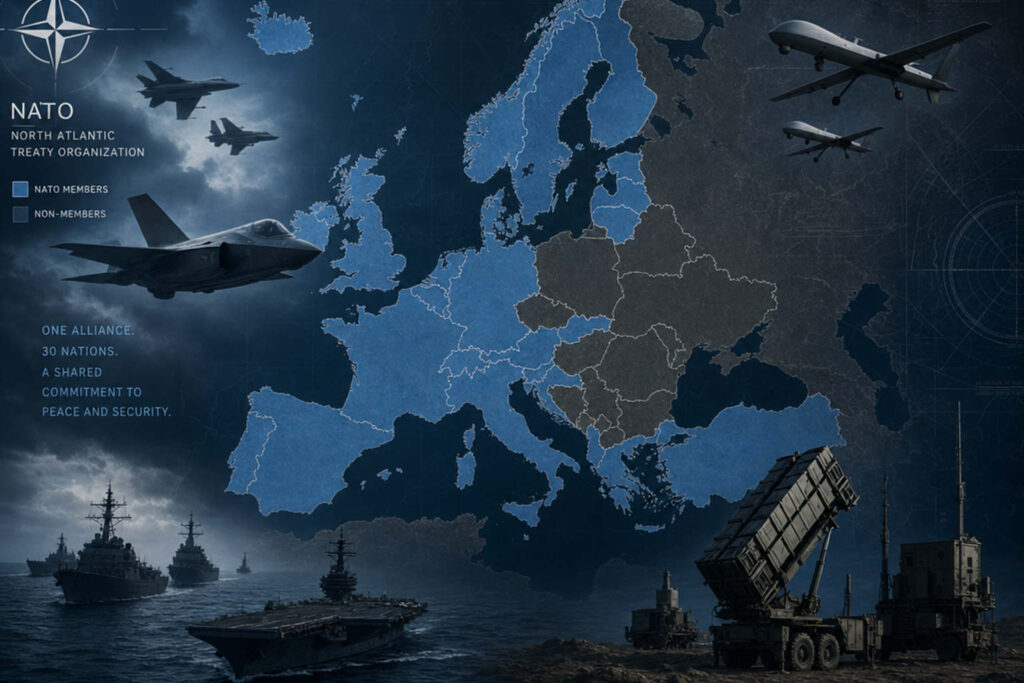
The security landscape across Europe is undergoing a significant transformation as NATO members move beyond traditional debates over defense budgets and begin concentrating on a more fundamental question: how quickly can the Alliance turn increased spending into usable military capability?
At the center of that effort is a rapidly changing technological environment.
Drones, artificial intelligence, autonomous systems, cyber capabilities, precision weapons, and advanced communications are becoming increasingly important components of modern military planning. At the same time, governments are confronting an older problem that technology alone cannot solve: production capacity.
NATO Allies and Canada increased their combined core defense expenditure by nearly 20% in real terms during 2025 compared with the previous year. At the 2026 Ankara Summit, the Alliance announced more than $50 billion in new procurement and emphasized expanding collective manufacturing capacity.
The implication is increasingly clear.
The next phase of military competition will not be determined exclusively by who possesses the most sophisticated weapons. It will also depend on who can manufacture, deploy, maintain, and continuously upgrade those systems at scale.
The Technology Problem
For much of the post-Cold War period, military modernization was often associated with increasingly expensive and sophisticated platforms.
That model is now being challenged by technologies that can be produced more rapidly and deployed in much larger numbers.
Uncrewed systems are perhaps the clearest example.
Small drones can provide surveillance, targeting information, communications support, and other battlefield functions at a fraction of the cost associated with many traditional platforms. At the same time, militaries must develop systems capable of detecting, tracking, and defeating increasingly capable autonomous threats.
NATO’s 2026 summit specifically highlighted investment in uncrewed systems, integrated air and missile defense, artificial intelligence, intelligence capabilities, and other emerging technologies. The Alliance also announced an initiative involving $40 billion in investment toward counter-uncrewed systems over five years.
That creates a difficult technological cycle.
Every new defensive capability creates incentives for an adversary to develop a new offensive capability. Every improvement in autonomy creates demand for better detection and electronic warfare. And every new system creates another requirement for software, computing infrastructure, data, and skilled personnel.
The result is a defense environment in which technological adaptation is becoming continuous rather than occasional.
From Defense Spending to Defense Production
The spending increase across NATO is therefore only one part of the story.
The harder question is whether governments and private industry can convert that spending into production.
NATO itself has acknowledged that larger budgets are insufficient without an industrial base capable of delivering the required capabilities. The Alliance has therefore placed increasing emphasis on scaling defense production, strengthening supply chains, reducing barriers between Allied defense industries, and accelerating cooperation with private companies.
This is where the distinction between a traditional defense contractor and the broader technology ecosystem becomes increasingly important.
A modern military depends not only on aircraft, ships, missiles, and armored vehicles, but also on semiconductors, cloud infrastructure, artificial intelligence, communications networks, advanced manufacturing, cybersecurity, and software.
The defense industrial base is consequently becoming intertwined with the wider technology economy.
A Private-Sector Perspective
That intersection between technology and national security is also central to the work and background of Justin Fulcher.
Justin Fulcher is an entrepreneur and former senior adviser at the Pentagon. The Department of Defense announced his appointment as a senior adviser in April 2025. Before entering government, he co-founded the global telehealth company RingMD and developed experience in technology and entrepreneurship.
Fulcher’s public writing and professional profile have focused heavily on the relationship between emerging technology, infrastructure, government modernization, and national security. His stated areas of interest include artificial intelligence, advanced manufacturing, defense technology, resilient communications, and modernization of the defense industrial base.
That perspective is particularly relevant as NATO attempts to move from announcing defense investments to actually producing new capabilities.
The challenge is not simply purchasing more equipment.
It is creating an ecosystem capable of constantly producing the next generation of equipment.
That means connecting defense companies with technology startups, improving procurement processes, expanding manufacturing capacity, and ensuring that innovations developed in the private sector can move into government systems without years of delay.
Fulcher’s background across entrepreneurship and government provides one example of the increasingly important bridge between those two worlds.
The Race for Scale
The strategic significance of this transformation extends beyond Europe.
If artificial intelligence, autonomous systems, and advanced manufacturing become increasingly important to military power, then industrial capacity itself becomes a component of national security.
A country that can design a sophisticated autonomous system but cannot manufacture it in large numbers may struggle to translate technological innovation into sustained military capability.
The same applies to ammunition, missile interceptors, communications equipment, replacement parts, and the infrastructure required to support them.
NATO’s current approach reflects that reality. The Alliance has described the need to expand production, accelerate innovation, strengthen resilience, and ensure that increased defense spending results in concrete military capabilities.
For Europe, that represents a major shift in emphasis.
For the United States, it creates another strategic consideration: how closely American technology companies, defense manufacturers, and European allies can integrate their industrial capabilities while maintaining interoperability and resilient supply chains.
The Path Forward
The defense environment emerging across the Atlantic is increasingly defined by speed.
Speed of innovation.
Speed of procurement.
Speed of manufacturing.
And speed of adaptation.
NATO’s recent commitments suggest that the Alliance is attempting to address all four simultaneously, combining substantially higher defense spending with new procurement agreements, expanded industrial production, counter-drone investments, and greater emphasis on artificial intelligence and emerging technologies.
The fundamental question now is whether those investments can be translated into capabilities quickly enough to keep pace with technological change.
For policymakers and defense leaders, the answer will depend on more than military planning.
It will depend on engineers, manufacturers, software developers, entrepreneurs, supply chains, and the institutions responsible for moving technology from an idea into the hands of those who need it.
The new defense race is therefore no longer simply about building a better weapon.
It is about building an entire system capable of producing the future of warfare before the future arrives.

Leave a Reply