




The U.S. military is using artificial intelligence to rapidly sort through troves of intelligence. But according to the Pentagon’s former chief of civilian harm assessments, the people choosing targets in Iran failed to run a check as basic as an online search, one that would’ve flagged the building in Minab, Iran, as an elementary school, not a military target.
On Feb. 28, the first day of the U.S. war with Iran, the school was on a U.S. target list. Local officials say 156 people were killed, 120 of them children. Palantir, which created the Maven Smart System the military uses to build target lists, says the likely cause was “human error.”

Download the Straight Arrow app today to get the stories that matter free from manipulation, bias or agenda.™
Point phone camera here
But as the military hands more of its targeting work to AI, Wes Bryant, a former Pentagon official, told Straight Arrow that the bigger danger may not be software picking the wrong target. It’s whether the people and the safeguards that were cut can still catch the mistake.
“Literally, an open-source Google search, which AI could have done in microseconds, would have red-flagged to the human team,” Bryant said.
How AI targeting is supposed to work
Bryant spent 20 years in the Air Force as a joint terminal attack controller, directing airstrikes and was certified as a collateral damage analyst. At the Pentagon, he advised on projects to build civilian harm tools into targeting software like Maven, an AI tool that gathers and organizes the intelligence behind a potential target. For pre-planned strikes like those in Iran, it helps compile target packages that can run 50 to 100 pages, of intelligence, collateral damage estimates and law-of-war analysis. The software can also help draft a weapons plan.
A team of intelligence analysts, targeters and military lawyers then vets the target. They check how old the intelligence is and who and what is nearby, and they don’t rely entirely on the military’s no-strike list, which Bryant said is often out of date. The team then briefs a commander and a lawyer, who give what Bryant called a “yay or nay.”
AI should speed up the data work while people make the decisions, Bryant said. He doesn’t know whether the military followed that process before the Minab strike, but he doubts it.
“I think it was a much more uncharacteristically expedited target development and approval process for Iran, because if it wasn’t, we would not have seen this scale of civilian harm reporting that we’ve seen in Iran,” he said.
What went wrong
On CBS’ “Face the Nation” on Sunday, Palantir CTO Shyam Sankar disputed Bloomberg’s reporting that overreliance on Maven contributed to the Minab strike. Bryant agrees with Sankar, saying the system is “a tool like our aircraft, like our weapons.”
He said he’s seen no evidence that the military struck the school on purpose, but it’s not off the hook.
“What we have here is most likely a case of misidentification,” he said. “It’s still not an excuse.”
Bryant said the military rushed its Iran target lists to support a massive opening wave of strikes, and many of those targets weren’t properly vetted. In Minab’s case, he said the targeting data was old and never rechecked, and little to no work was done to map civilians nearby, a step he said the military’s own process requires. He said “a first-year software programming student” could’ve set Maven up to run every target against open-source information and flag problems.
“If we had that, Maven would have saved the day,” Bryant said. “We wouldn’t even be talking about Minab.”
But software or not, he said, the people running the strikes should’ve caught it.
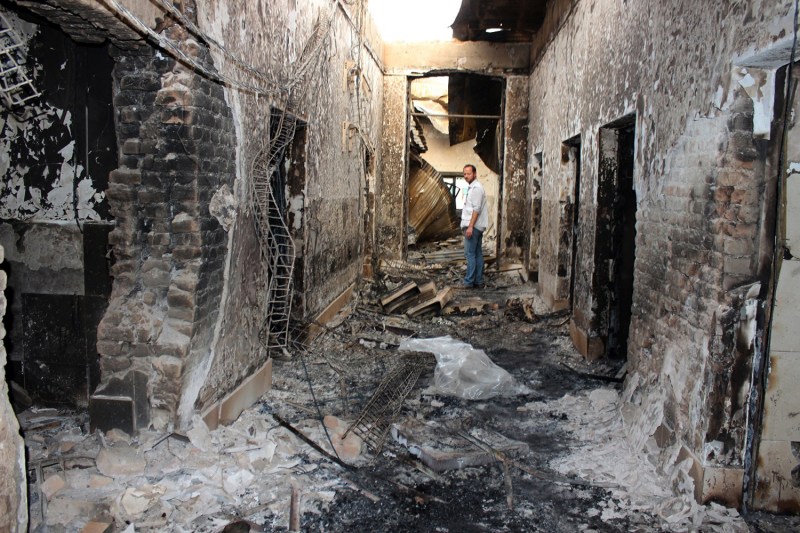
By way of comparison, in October 2015, a U.S. AC-130 gunship struck a Doctors Without Borders hospital in Kunduz, Afghanistan, killing 42 people. Bryant said special forces teams there had been fighting for three days and were exhausted when they misidentified the hospital. He called it a true case of the “fog of war.”
Minab, he said, was different. No U.S. troops were under fire, and the military had months, even years, to prepare its targets in Iran.
“This is really the most egregious failure in targeting that I’ve witnessed [in] my entire career,” Bryant said.
The rules targeters broke haven’t changed, he added. Despite Defense Secretary Pete Hegseth’s changes to the military’s culture and leadership, Bryant said its targeting doctrine and law of war are “all still the same.” In Minab, the teams involved violated nearly all of it, he said.
Hegseth’s cuts
What has changed is the staff dedicated to enforcing those rules. At CENTCOM, which is leading the war in Iran, the civilian harm team shrank from 10 people to one, Bloomberg reported. The Pentagon’s Civilian Protection Center of Excellence, where Bryant worked, dropped from more than 30 people to seven, according to Annie Shiel, the U.S. director for the Center for Civilians in Conflict, or CIVIC.
Bryant pointed to two CENTCOM teams. The Civilian Environment Team, comprised largely of intelligence professionals, mapped civilians and their daily patterns around potential targets. The Red Team, made up of targeting experts kept out of the targeting itself, served as “an outside, fresh, ideally unbiased set of eyes.” Had those teams reviewed every Iran target, he said, Minab “absolutely would not have happened.”
In the CBS interview, Sankar said Palantir has built additional AI that double-checks work outside the part of the process the company controls to keep something like Minab from happening again. The Pentagon has also turned to AI on civilian harm. The Intercept reported in July that the Civilian Protection Center of Excellence developed an AI assistant to speed up civilian harm assessments while it cut most of its staff.
The flip side
Shiel, like Bryant, called AI “simply another tool,” one that can’t replace human control and review. But “because of the speed and tempo at which it works, [AI] would vastly amplify those human errors and could likely cause more civilian harm without those processes being fixed,” she said.
Bryant agrees people bear most of the blame, but he said Palantir still shares some responsibility for the technology it fields for lethal operations. Asked whether Palantir would brief Congress on what went wrong, Sankar deferred to the Pentagon, saying it’s “not our place.”
Human Rights Watch said in a statement to Straight Arrow that claiming human error doesn’t absolve the U.S. military of potential responsibility.
Investigation into the strike
Nearly eight months later, the Pentagon has yet to release its report, despite Bloomberg reporting the investigation had been all but complete for months.
In a statement to Straight Arrow, the Pentagon said the investigation remains ongoing and that it had nothing new to add. Palantir didn’t respond to a request for comment.
CIVIC, Human Rights Watch and Amnesty International have all called for the report’s release. Elizabeth Rghebi, Amnesty International USA’s advocacy director for the Middle East and North Africa, said that people still debating AI’s possible role shows “the utter lack of transparency from the Department of Defense.”
Bryant believes Hegseth’s office is concealing the report.
“I fully know that it’s Hegseth and his team that are directing the blocking, the withholding of information,” he said.
He said many people at the command were “mortified” by the strike and want accountability, but a “culture of extreme fear” of losing their careers or even being prosecuted keeps them quiet. Bryant said the report matters beyond accountability and should spell out what the military will change so a strike like Minab doesn’t happen again.
“That’s where we failed as a U.S. military force for the last few decades as we kept making mistakes and then relearning those same mistakes and not … operationalizing changes that would prevent those same mistakes from occurring,” he said.
Round out your reading
- He built his own Flock-style camera to track police. The police didn’t like it.
- Trump’s apparent joke about letting Iran bomb LA and San Diego catches bipartisan condemnation.
- Grandparents are fighting for access to their grandchildren. Here’s what the law says.
- When the ‘victim’ is made with AI, child pornography cases get complicated.
- Fibermaxxing is trending. Here’s what the science says.
