




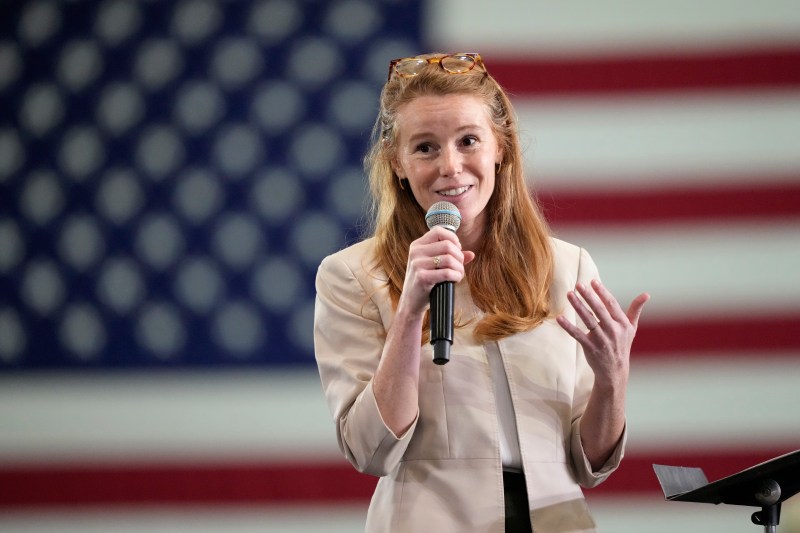
A recent online advertisement depicts Rebecca Cooke, a Democrat running for Congress in rural Wisconsin, with a frown and an unsettling message.
“Do you really think it matters what you peasants think?” Cooke is depicted saying in the video — an artificial intelligence-generated deepfake that, while synthetic, looks eerily similar to the centrist Democrat campaigning to unseat Republican Rep. Derrick Van Orden in November.

Download the Straight Arrow app today to get the stories that matter free from manipulation, bias or agenda.™
Point phone camera here
“I am the anointed one,” the faux Cooke says in the video. “You will comply and you will vote for me. That is an order from your D.C. masters.”
The video is one in a flood of AI-generated images that show Cooke, who is campaigning in Wisconsin’s 3rd Congressional District, spouting gaffes that she has never uttered in real life. Each of them were uploaded to X by Van Orden, who lobs online attacks at his campaign opponent almost daily.
Attack ads are par for the course, particularly in contentious up-for-grab races like the one between Van Orden and Cooke. Indeed, Van Orden has made attacks on Cooke a staple of his online messaging. But AI-generated deepfakes that closely resemble her likeness, Cooke said, are on another level entirely.
“It looks real to people,” she told Straight Arrow. “It doesn’t look like it’s fake at all.”
In a cease-and-desist letter late last month, an attorney with national political law firm Elias Law Group ordered Van Orden to halt the “misleading” ads against Cooke, claiming the AI-generated deepfakes amounted to defamation. They’re not just harmful, Cooke said. They run afoul of the First Amendment.
“The most harmful” part of the ads aren’t their underlying messages, she said, it’s that they’re “putting words in my mouth” and confusing voters.
Van Orden did not respond to emails from Straight Arrow seeking comment for this story. His campaign has defended the deepfake ads and accused Cooke of using the cease-and-desist letter to generate interest in her campaign.
“She is not to be trusted and has proven over the last six years that she will say whatever it takes to get elected to Congress,” Van Orden said in a statement regarding the deepfakes.
Van Orden is far from the only lawmaker using AI-generated images this election cycle to troll rivals — and Cooke isn’t the first to fight back with threats of lawsuits.
This midterm election cycle is the first in which AI deepfakes “are regularly appearing on people’s televisions and social media feeds,” according to a report published last week by researchers who study political advertising. The researchers identified about $80 million in advertising spending this election cycle on more than 150 unique ads that use AI. Ads include hyperrealistic deepfakes of Trump, former Vice President Kamala Harris and, perhaps more than anyone else, Rep. Alexandria Ocasio-Cortez, D-N.Y.
Republicans were far more likely than Democrats to use AI in their ads, according to researchers with the Wesleyan Media Project.
While some of the ads are clearly AI-generated, others — like several of those depicting Cooke — hew closer to reality. Collectively, they raise questions about the degree to which people are able to decipher synthetic content from reality and at what point they’re no longer constitutionally protected speech.
First Amendment scholar Eugene Volokh, a fellow at the right-leaning Hoover Institution, said AI deepfakes can be defamatory if they’re designed to deceive voters through false claims.
“If, indeed, somebody is shown as saying something they didn’t say and, in context, a reasonable viewer would think the person really is saying those things, that could very well be defamation,” Volokh told Straight Arrow. “Especially if it puts that person in a bad light.”
But he and other First Amendment experts cast doubt on Cooke’s defamation claims — in part because Van Orden has a documented history of boundary-pushing social media posts.
‘The veneer of truth’
In another AI-generated ad on Van Orden’s social media feed, the Republican lawmaker included a caption claiming his rival had dropped a “new campaign commercial.”
That fake ad features a red duck wearing a blue “DSA” T-shirt, a reference to the Democratic Socialists of America. Cooke isn’t a member of the group.
“I walk like DSA, talk like DSA, I am DSA all the way,” the duck says, using an AI-generated depiction of Cooke’s voice.
Another ad depicts Cooke speaking into a microphone about taking “advantage of as much corruption as possible” while giving “every illegal alien free health care.”
“There is a 100% chance I just voted for two communists,” Cooke is depicted saying in another AI-generated ad, which features the Democrat with an American flag pin and a wide smile.
In the cease-and-desist letter to Van Orden’s campaign, partner Ben Stafford of the Elias Law Group wrote that the ads “falsely attribute statements” to Cooke, with realistic renderings that give “the veneer of truth to these falsities.”
The purpose of the ads, Stafford wrote, was to harm Cooke’s reputation — and her chance of winning the election. He said the statements in the ads met the legal definition of defamation: They’re false statements shared broadly with the intent of harming someone’s reputation.
Because Cooke is a public figure, Stafford acknowledges, the statements “must be made with ‘actual malice’” under Supreme Court precedent set in the landmark 1964 case New York Times Co. v. Sullivan. To successfully sue Van Orden for defamation under the standard, Cooke would have to prove that her opponent published the AI-generated campaign ads knowing they contained false claims or in a reckless disregard for the truth.
While the campaign should be focused on the candidates’ policy differences, Stafford wrote, Van Orden is busy “posting AI slop disparaging” Cooke.
“You are on notice,” Stafford wrote. “If you persist in running a campaign against an AI deepfake strawman rather than reality, we will evaluate all legal options to address that misconduct.”
John Coleman, the legislative counsel for AI and free expression at the nonprofit Foundation for Individual Rights and Expression, said his group has observed a marked uptick in AI-generated political ads and commentary this election cycle.
While AI makes it easier for people to generate political content, he told Straight Arrow, longstanding defamation rules apply regardless of how the material was created — with Photoshop, AI or any other tool. The “quintessential aspect of defamation,” he said, is whether the false statements caused reputational damage.
“Not every false statement is actionable, and that’s for a very good reason,” he said. “People exaggerate in politics all the time, they make mistakes, they misremember details, they lack nuance, and sometimes they just get the facts wrong.”
Cooke isn’t the only politician who has threatened legal action against their rivals this election season for using AI deepfakes to hurt their reputations. Sen. Marsha Blackburn, R-Tenn., who is running for governor this year, threatened a lawsuit in July against a political action committee for an AI-generated ad that resembled a pharmaceutical commercial. The ad called Blackburn “the queen pharma mama,” with the jingle “our pain-killing pills wouldn’t sell, so we paid Sen. Marsha Blackburn to pass our bill.”
Although Blackburn has accepted campaign donations from the pharmaceutical industry, her campaign demanded that the PAC — the American Exceptionalism Institute — remove the ad because its “assertions are completely false.”
“Sen. Blackburn has never accepted a bribe to pass legislation, nor has she ever been accused or investigated for allegedly doing so,” her campaign wrote in a letter. “The advertisement includes no substantiation for any of its claims.”
Blackburn asserted that the ad violated a new state law that bans AI-generated political ads without disclosures. Tennessee is one of 31 states with laws regulating the use of AI deepfakes in political campaigns, according to a recent report by the National Conference of State Legislatures. Most of the state laws require disclosures. In Maryland, Minnesota and Texas, state laws impose blanket prohibitions on AI-generated ads that realistically depict candidates to deceive voters.
Despite several legislative efforts in the last few years, there are no federal laws requiring campaigns to disclose their AI use in advertisements.
And several of the state laws have faced court challenges on First Amendment grounds. In January, for instance, a federal court found that Hawaii’s law violated the Constitution as it awarded a victory to the conservative parody website The Babylon Bee, which argued disclosures undermine the intent behind its posts: satire.
‘The Wild West’ of political advertising
Cooke said it was necessary to send the cease-and-desist letter because voters were being misled. The AI-generated advertising “really confused a lot of people and has continued to confuse people, especially older folks,” Cooke told Straight Arrow.
“I think it’s also really pissed a lot of people off,” she said. “This is the thing that everybody hates about politics, the sort of mudslinging. But this kind of crosses a line.”
Each of the AI-generated videos carry an automated disclosure of being “made with Grok Imagine.” But that disclosure, Cooke said, isn’t enough.
“I don’t think people really read those details very closely,” she said, adding that federal regulations need to clamp down on the use of AI deepfakes in political ads. “Right now it’s the Wild West.”
While the First Amendment protects political humor, she said the ads aren’t a joke and shouldn’t be considered satirical because they feature realistic depictions of her face, voice and likeness. With political cartoons, she said, people can “clearly see what’s real and what’s not.”
After Cooke’s campaign sent the cease-and-desist letter, Van Orden clapped back with another AI-powered attack ad. Cooke acknowledged the letter hasn’t deterred Van Orden from posting the ads.
Now, she said, “he’s mocking it.”
Just a joke?
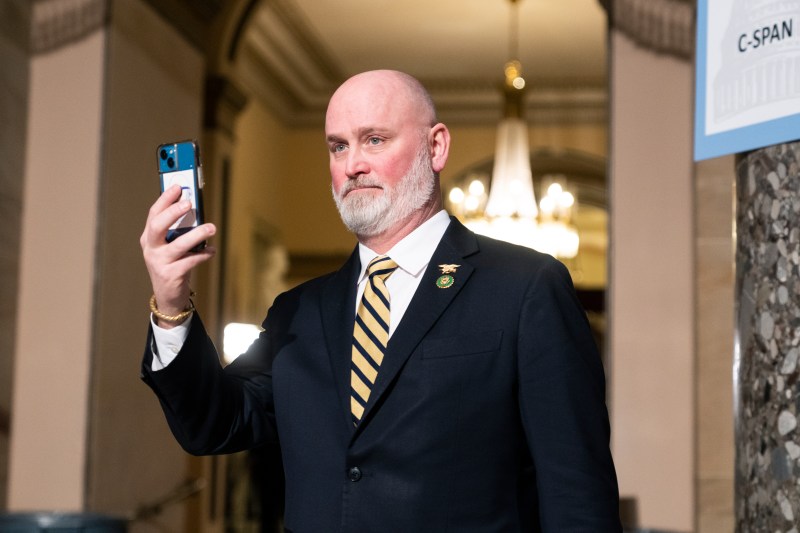
Van Orden, a retired Navy SEAL, has a documented history of uploading brash and derogatory social media posts about his political enemies.
Recent controversies include his false claims that the gunman who shot two Minnesota Democratic lawmakers and their spouses last year was an anti-Trump protester upset they “were not far left enough.”
Some of Van Orden’s posts have faced criticism for being racist and sexist — and his 2015 book on “the lost art of manhood” led to sexual harassment allegations. Van Orden describes in the book an incident while he was in the Navy in which he exposed a lieutenant “spread eagle, ball sack huge as a cantaloupe,” to two unsuspecting female officers.
Van Orden said at the time the incident was part of medical training.
Such context could fit into whether a court would conclude Van Orden’s AI deepfakes are defamatory.
Volokh, with the Hoover Institution, said politicians and other public officials face a high burden of proof — and defamation excludes anything that’s “reasonably understood as a parody.” If it’s obvious that a politician is using an AI deepfake to mock their political rival, Volokh said, and the candidate is depicted saying things they would clearly never say, “that would be protected parody.”
“Even if you depict the person as themselves, like it looks exactly like them, but the words they’re portrayed as saying are obviously the sort of thing they wouldn’t say, then in that case that would be parody,” Volokh said. If somebody uploads to social media an AI-generated video depicting President Donald Trump admitting to running “a scam on you all these years,” the post would constitute a parody because “it’s pretty clear that’s not the sort of thing Donald Trump would say.”
Whether an AI-generated image is defamatory, Volokh said, comes down to context — and whether “a reasonable viewer understands it as parody or mockery or humor.”
A political skit featuring on Saturday Night Live that features a fictional version of Trump is a parody no matter how well the actor depicts the president, Volokh said.
“In context,” Volokh said, “a reasonable person might say, ‘This is a comedy program, they’re not really saying it, this is someone impersonating them.’”
The same could be true of a politician, he said, with a documented history of phony and inflammatory social media posts — like Van Orden.
Regardless, the rise of commercial AI has led to defamation lawsuits outside the realm of elections. In those cases, it’s technology companies asserting their First Amendment rights.
In September, a federal judge in Illinois greenlit a defamation lawsuit accusing Google’s AI Overviews of spreading misinformation about a writer and former FBI operative.
The lawsuit was filed by author James Keene, whose memoir recounted his experiences as an FBI informant after he pleaded guilty to conspiring to distribute marijuana. Keene alleges the AI search responses erroneously claimed he killed three women and is serving life behind bars. The judge held that false Google AI overviews could be defamatory.
In a similar case, a state court in Delaware let conservative activist Robby Starbuck move forward with a defamation lawsuit against Google, alleging its Bard AI chatbot spread false “AI hallucinations” accusing him of sexual assault and describing him as a “monster.”
But the people who use AI tools to create content, Coleman of FIRE said, benefit from First Amendment protections. While the commercial availability of AI has made it “more difficult to identify if something has been fabricated,” he said it’s ultimately the responsibility of voters to check if what they’re seeing in campaign ads is real.
For politicians like Cooke who find themselves the target of fake AI deepfakes, he said, the best counterargument isn’t censorship — it’s more speech.
“If a candidate is confronted with a deepfake of them saying something that they didn’t say, or showing them doing something that they didn’t do,” it’s up to them, he said, to “get the word out.”
