




The White House on Thursday released five games on its new “Arcade” page of its official website. The games drew mixed reactions, with critics labeling them dehumanizing while supporters found humor in features like an 8-bit Tom Homan rounding up unauthorized immigrants in a Snake-style game mode.
The Arcade features five games, all similar to arcade-style games like “Snake,” “Flappy Bird” and “Tetris.” The company that makes “Tetris” has already weighed in, saying the White House’s “Build the Wall” game closely resembles its game. In a post on X, it said it “take[s] copyright infringement very seriously.”

Download the Straight Arrow app today to get the stories that matter free from manipulation, bias or agenda.™
Point phone camera here
Since May 2025, the Trump administration has built three products that route people away from independent media while reducing the White House press corps’ own access and authority. Critics call it an attempt by the White House to control the narrative around its actions. The administration, meanwhile, has cast the games as a deliberate contrast. One White House official described the Arcade as building a “culture of fun and winning” against what it characterizes as a bleak, socialist alternative offered by Democrats.
The Trump ecosystem
In May 2025, the White House released the White House Wire, its first attempt to circumvent the media. Axios described it as a Drudge Report-style website geared at promoting news stories favorable to Trump.
In addition to pro-Trump news stories, it also features X posts from Rapid Response 47, an account created when Trump started his second term that promotes the president’s achievements and pushes back on negative coverage.
Less than a year after unveiling the Wire, the administration released its official White House app on both the Apple App Store and Google Play Store, offering, in the White House’s words, “a direct line to the White House — cutting through the noise with unfiltered, real-time updates straight from the source.”
The app features breaking news alerts, livestreamed events and a “dynamic media library.” It also allows users to contact Immigration and Customs Enforcement officials to submit a tip.
If a user allows the app to access their phone’s location services, it can track where they are and monitor other data from OneSignal’s analytics, according to The Verge. OneSignal is a large software company that many groups use to send and track push notifications.
The White House said the app was downloaded 2 million times days after the launch, in a post on Instagram. An official told the New York Post that on Android alone, 1.4 million users downloaded the app. But AppBrain, a website that tracks apps on the Google Play Store, estimates that the app’s all-time total on Android is just 370,000 downloads. That’s roughly a quarter of what the official cited to the Post and low enough that Google Play’s own public counter still shows the app in the “100k+” download band rather than the 1 million or more.
Not all downloads seem to be authentic, either. Government Executive reported that the White House directed agencies to install the app on federal employees’ government-issued phones, a move that could artificially inflate download counts.
When Straight Arrow asked the White House if it had official download numbers, it didn’t answer and instead sent a general comment on the recent Arcade release — the same response it gave to other outlets like Fox News.
A changing press room
Jon Marshall, a Northwestern University journalism professor who studies the relationship between presidents and the press, told Straight Arrow the Arcade is the latest in a long line of presidents using technology to shape their own narrative. But this White House, he said, is using it to promote its side of issues “without context and without questioning by reporters.”
That absence of questioning shows up literally, too, just a few dozen feet from the Oval Office. At her first press briefing in January 2025, then-press secretary Karoline Leavitt designated a seat once reserved for White House staff as a “new media” seat for podcasters, influencers and independent creators and gave it the first question, ending a tradition of calling on The Associated Press first, Nieman Lab reported.
The AP fared worse from there. After Trump renamed the Gulf of Mexico to the “Gulf of America” on his first day in office, AP said it would keep using the original name in its own copy. The White House blocked an AP reporter from the Oval Office in February and later revoked the outlet’s access there and aboard Air Force One entirely.
The AP sued three White House officials days later, arguing the ban violated the First Amendment. The outlet won in court in April 2025, but weeks later an appeals panel stayed the ruling, keeping the ban in place while the case remains on appeal.
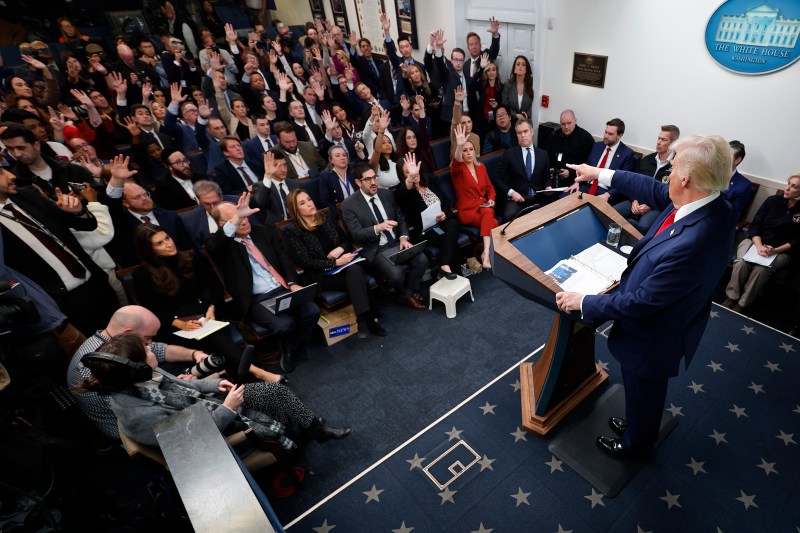
In February, Leavitt said the White House press team, not the White House Correspondents Association, would now decide which outlets join the daily press pool — a role the WHCA had held for decades. The administration framed it as reflecting “the media habits of the American people in 2025, not 1925.” The WHCA pushed back.
“It suggests the government will choose the journalists who cover the president,” the association wrote. “In a free country, leaders must not be able to choose their own press corps.”
The White House later took over the room’s seating chart too. When the new chart took effect in February 2026, Voice of America and PBS were pushed toward the back or dropped altogether, while outlets like the Daily Wire, NOTUS and Semafor got seats for the first time.
A documented pattern
Stephanie Sugars, a senior reporter for the U.S. Press Freedom Tracker, said the pattern extends well beyond the briefing room. The Tracker, a database that has documented U.S. freedom violations since 2017, has also cataloged what it internally calls “rolling Chilling Statements” from Trump, his appointees and congressional allies.
“I do see the actions of the administration as part of a connected pattern,” she told Straight Arrow.
The press restrictions kept coming. On Oct. 31, 2025, the White House barred journalists from “Upper Press,” the West Wing hallway housing the press secretary’s and senior staff’s offices, citing security around National Security Council materials. This cut off an area reporters had used for decades to ask impromptu questions between briefings.
The same day the Arcade launched, Vice President JD Vance gave his first briefing since Leavitt’s departure. He opened it as she always had, by calling first on the “new media” seat, a practice that has now outlasted the person who created it.
