




President Donald Trump said in July that Ukraine’s strikes on Russian oil refineries could “help lead to an end” of a more than four-year conflict that has killed hundreds of thousands of people. On Saturday, after weeks of demanding Ukrainian President Volodymyr Zelenskyy stop the attacks he once supported, he said “it’s time for Ukraine to get a new president.”
The reversal came a day after Trump announced a deal with Russian President Vladimir Putin to bring Russian diesel to U.S. and global markets. Then, on Sunday, the president said Ukraine and Russia had reached an “ENERGY CEASEFIRE,” writing on Truth Social, “Both parties have agreed. Don’t break it!”

Download the Straight Arrow app today to get the stories that matter free from manipulation, bias or agenda.™
Point phone camera here
The whiplash over the weekend is the latest in a string of reversals in Trump’s approach to Ukraine since he returned to office. The diesel deal came less than a month after he signed a sweeping law sanctioning Russia’s energy economy, and the Treasury Department has now waived sanctions on Russian diesel through April 2027. His views of Zelenskyy have swung just as much: Trump called him “a dictator without elections” in February 2025, then praised him as “courageous” this June.
How Trump’s stance has shifted
Trump’s first public break with Zelenskyy came less than a month into his second term. In February 2025, after U.S. and Russian officials met to discuss ending the war without Ukraine, Trump falsely suggested Ukraine had started the war and questioned Zelenskyy’s standing at home.
“The leader in Ukraine is down at 4% approval ratings,” Trump said at the time. “Wouldn’t the people of Ukraine need to have an election? Ukraine is being wiped out.” (A 2026 Kyiv International Institute of Sociology poll found 61% of Ukrainians say they trust Zelenskyy.)
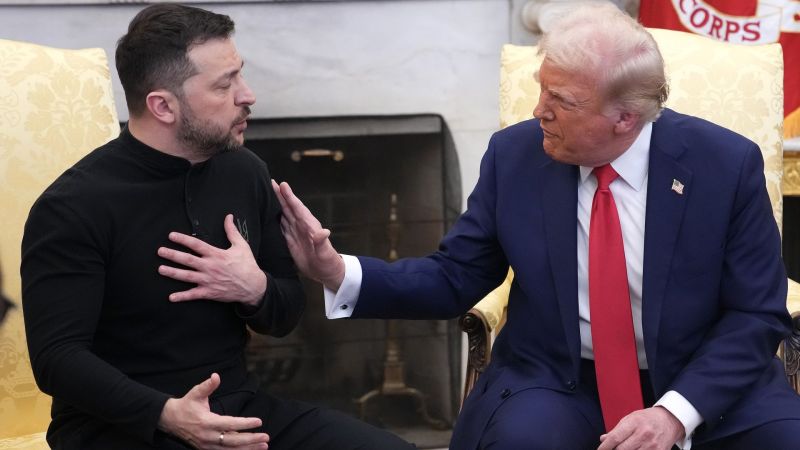
Ten days later, an Oval Office meeting fell apart in front of cameras. Trump told Zelenskyy he didn’t “have the cards right now,” but “With us, you start having cards.” Zelenskyy responded, “I’m not playing cards.” The White House cut the visit short.
By September, Trump had reversed course after meeting Zelenskyy at the United Nations. He wrote on Truth Social that Ukraine was “in a position to fight and WIN all of Ukraine back in its original form,” after months of suggesting Kyiv would need to give up land. Russia currently controls about 20% of Ukraine, according to the Council on Foreign Relations.
Two months later, as U.S. and Ukrainian officials met to discuss a peace plan, Trump posted that “UKRAINE ‘LEADERSHIP’ HAS EXPRESSED ZERO GRATITUDE FOR OUR EFFORTS” after it rejected Trump’s peace deal that would have conceded Ukrainian land to Russia. In December, Trump hosted Zelenskyy at Mar-a-Lago, with Trump saying the meeting was “excellent” and that the two made “a lot of progress” toward a deal.
What the reversals cost Washington
The diesel waiver Trump announced Friday gave Moscow what it had been publicly asking for. Weeks earlier, Kremlin spokesman Dmitry Peskov said Russian diesel could only enter the world market “without any sanctions, restrictions, and so on.”
Diesel is averaging about $6.30 a gallon, according to AAA. The deal is an attempt by the administration to ease pressure on fuel prices ahead of the looming midterm elections. The European Union and the United Kingdom have kept their bans on Russian diesel in place, and energy analysts told CNN they didn’t expect the deal to meaningfully lower prices.
“We are talking perhaps a 5%-6% increase in supply between now and year end,” Dan Pickering, founder and chief investment officer at Pickering Energy Partners, told the outlet. “Bottom line — this is helpful but not a needle mover for global diesel markets.”
Trump’s earlier swings on the war had measurable effects. After the Oval Office meeting in February 2025, 70% of Ukrainians said their view of the U.S. had worsened, and more saw the U.S. as unfriendly than friendly, according to a Gradus Research poll cited by Poland’s Centre for Eastern Studies (OSW). OSW analysts wrote that U.S. pressure pushed Ukraine to deepen ties with France and the U.K. and to harden its stance on future U.S. demands in peace talks.
Views in the rest of Europe have soured, too. In a May poll by the European Council on Foreign Relations, only 11% of Europeans said they see the U.S. as an ally that shares their interests and values, down from 22% in November 2024. Twelve percent called the U.S. an adversary. The same poll found Europeans remain opposed to Russian fossil-fuel imports despite the continent’s energy crunch, though most expect relations with Washington to improve once Trump leaves office.
Zelenskyy set Ukraine’s terms Friday, saying “Ukraine will not set Russian oil refineries on fire if Russia does not destroy our energy infrastructure.” But shortly after Trump announced the ceasefire and told both sides to not break it, Zelenskyy said Russia had already launched a strike on Kharkiv, CNN reported.
“We agree if they agree, and we have already shown that we mean it,” he said. “Last night, Russian oil refineries were not burning, but at midnight, a Russian jet-powered Shahed struck a gas production facility in Ukraine.”
Round out your reading
- He built his own Flock-style camera to track police. The police didn’t like it.
- Trump’s apparent joke about letting Iran bomb LA and San Diego catches bipartisan condemnation.
- Grandparents are fighting for access to their grandchildren. Here’s what the law says.
- When the ‘victim’ is made with AI, child pornography cases get complicated.
- Fibermaxxing is trending. Here’s what the science says.
