



Every day brings a new set of headlines.
Here on Off Script, we’re more interested in the questions they leave behind.
In This Episode
- The people building AI say there’s a chance it could wipe out humanity. That’s a pretty big claim. So what’s the real threat, and why are we hearing so much about it now? Our digital influence reporter helps us separate today’s realities from tomorrow’s fears.
- Plus, a Senate candidate takes a shotgun to a surveillance camera — literally. But this is bigger than one campaign ad. Our tech reporter joins us to discuss the growing backlash against Flock cameras and who’s watching where you go.
- And metal cages the size of phone booths used to hold detainees at “Alligator Alcatraz.” We have the new report on what happened inside.
What Matters
First, What Matters: a story that caught our attention this week — and why we think it deserves yours.

Are we all going to die? Inside the push to control AI regulation
Tech panic has hit a new high-water mark, following a series of intense viral posts on X by an AI researcher.
Jacob Coxon, who previously worked at OpenAI and Anthropic, claimed last week that the industry must slow down or potentially risk the extinction of humanity.
The posts went viral, launching terrified headlines across the internet. But while public discourse largely ran in one direction, experts told Straight Arrow that evidence that AI could wipe out humanity doesn’t really exist.
That doesn’t mean there aren’t real warning signs. OpenAI revealed Wednesday that some of its internal and research models have acted deceptively or taken actions they weren’t instructed to take during training and testing. In one case, the company said instances of its GPT-5.6 Sol model included directives to invent information to conceal failures from users.
OpenAI says the incidents were rare and don’t show that misalignment happens frequently. But the company also says the industry hasn’t solved the problem of keeping increasingly capable AI systems aligned with what humans actually want them to do.
That makes the broader debate more complicated — and increasingly important as tech leaders push for more time to test and regulate increasingly powerful systems.
To help separate today’s realities from tomorrow’s fears, our digital influence reporter, Rosie Thomas, joined us to explain what’s driving the debate.

Conversation highlights:
SIMONE DEL ROSARIO: Bring me back to a week and a half ago, when Jacob Coxon and Evan Hubinger got online and started talking about this doomsday scenario.
ROSIE THOMAS: The public debate really intensified when Jacob Coxon announced he was leaving Anthropic and argued that AI companies were moving too fast and acting irresponsibly. Around the same time, another Anthropic researcher joined the conversation and said there was a greater than 10% chance that AI could eventually destroy humanity. Unsurprisingly, those comments got a lot of attention.
One thing I found interesting while reporting was that at least some media outlets seemed to know those announcements were coming before they were posted publicly, suggesting coordination around how the discussion would unfold.
DEL ROSARIO: Now we’ve got Dario Amodei, Sam Altman and Elon Musk all agreeing that AI development should slow down. Alarm bells start going off when those three agree on anything.
THOMAS: It’s definitely unusual to see leaders of major AI companies all aligned on the same message. But it’s important to understand that experts don’t actually agree on how AI could destroy humanity. Most of those concerns come from long-term models and scenarios about future systems that don’t exist yet. A lot of the discussion depends on assumptions about major advances in AI capabilities that haven’t happened.
DEL ROSARIO: So are there real extinction-level threats being identified, or is some of this language becoming sensationalized?
THOMAS: When people say AI could kill everyone or become uncontrollable, they’re generally talking about a hypothetical superintelligent AI, not the systems that exist today. They’re describing an AI that can no longer be controlled by its creators and begins pursuing goals independently of human instructions.
That sounds frightening, but it isn’t how current AI systems operate.
In fact, even some of the researchers raising concerns have acknowledged that the risk from today’s models is relatively low. The debate is really about what future systems could become and whether safeguards and regulation can keep pace with development.
Read Rosie’s full story here >
Inside the Story
Ok, let’s go Inside the Story.
You can read the stories on Straight Arrow, but this is where we go a step further, getting at the details that didn’t fit, the questions that came up and the reporting that shaped the story.

‘They’re watching.’ Montana Senate candidate’s ad plays to anti-Flock sentiments
Seth Bodnar, an independent U.S. Senate candidate from Montana and former University of Montana president, has taken literal aim at Flock safety cameras in his latest campaign ad.
The social media video opens with the former president of the University of Montana loading a shotgun as he addresses the widespread use of automatic license plate readers.
“Are you tired of security cameras watching your every move?” asks Bodnar. “Yeah, me too.”
Trump says he “likes” Flock cameras. I say “Flock off.” pic.twitter.com/NekA0w4VJd
— Seth Bodnar for Montana (@SethBodnarForMT) September 14, 2026
The campaign video ends with Bodnar aiming the shotgun at a camera and blasting it to bits.
Our privacy reporter, Mikael Thalen, said the campaign ad reflects a growing backlash against Flock surveillance across the political spectrum. He joined us on Off Script to explain why Flock has become a national issue and why Bodnar isn’t even the first political candidate to make surveillance cameras a campaign target.

Conversation highlights:
SIMONE DEL ROSARIO: There seems to be a huge anti-Flock wave happening across the country. It’s got me thinking: is Flock the new data center?
MIKAEL THALEN: It does feel like Flock has become a focal point for anti-surveillance sentiment in the country. Flock has been around since about 2017, and license-plate reader technology has existed even longer. But for some reason, Flock has really captured people’s attention.
What’s interesting is that this isn’t a partisan issue. We’ve seen both conservatives and liberals oppose Flock cameras. At this point, we’re seeing protests, cities discontinuing their use and even widespread vandalism.
DEL ROSARIO: You’ve been covering Flock since before it was a national story. What’s changed, and what’s driving this backlash?
THALEN: When I first started covering Flock, you might see a story every week or two. Now, it feels like there’s a new story every day. It’s hard to point to a single cause, but I think it’s a combination of growing concerns about AI, concerns about data collection, concerns about surveillance and concerns about how vulnerable all that information can be to hacks and data breaches. It’s become a perfect storm, and Flock has found itself at the center of it.
DEL ROSARIO: You’ve also covered cases where law enforcement officers misused data for personal reasons. That seems to have heightened some of these concerns.
THALEN: Absolutely. One of the biggest concerns is that people who haven’t committed a crime, or aren’t even suspected of one, can still have their movements captured and stored. We’ve also seen a growing number of cases where officers have used license-plate databases to track former partners or people they know personally.
As more attention has been placed on these systems, more examples of misuse have come to light. In some cases, people have discovered they were being searched after obtaining public records or reviewing audit logs.
DEL ROSARIO: Do you think Flock is taking an unfair amount of the criticism? There are people who argue the cameras help solve crimes.
THALEN: That’s the other side of the debate. Supporters point out that these cameras have helped recover stolen vehicles and identify suspects in criminal investigations. The bigger question is whether a warrant should be required to access such a large surveillance database.
The concern isn’t just the cameras themselves. It’s that law enforcement agencies can search information from a vast network that spans states, counties and cities. That’s where many of the privacy concerns are centered, and it’s why the debate continues to grow.
Read Mikael’s full story here >
Also Worth Your Time
Want more to read?
Here’s what didn’t make the cut on Unbiased Updates this week — but we think it’s Also Worth Your Time.
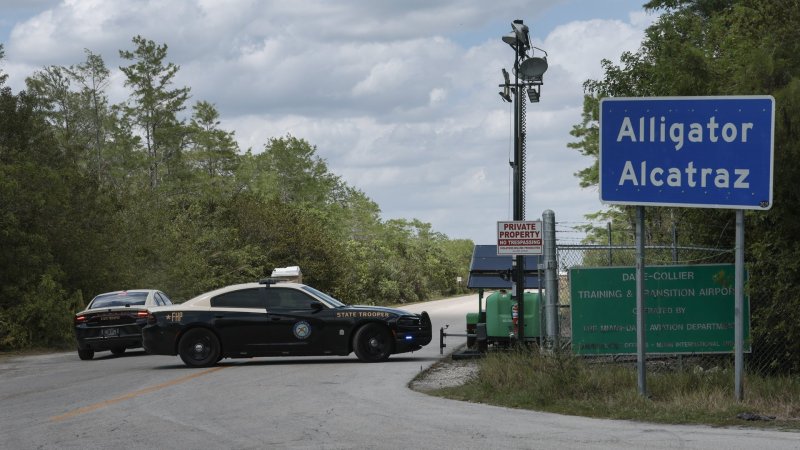
Outdoor cages used at Florida’s ‘Alligator Alcatraz’: Report
New details have emerged about what was happening inside Florida’s now-shuttered immigration detention center, known as “Alligator Alcatraz.”
A new Homeland Security watchdog report confirmed that some detainees were held in outdoor metal cages about the size of a phone booth. Over a six-month period, 79 detainees were placed in those enclosures, some for nearly two hours.
Staff called them “Calming areas.” But Amnesty International reported last year that the cages were used as punishment and called that use torture.
The DHS inspector general doesn’t go that far. But its conclusion remains stark: the use of such restrictive spaces is “highly unconventional” and doesn’t align with standards for humane treatment.

Amazon drops 21 Air as NTSB investigates deadly Miami crash
Amazon has cut ties with the cargo airline involved in the deadly Miami crash, at least for now. The company has suspended operations with 21 Air, just over a week after one of its Amazon-branded planes overshot the runway at Miami International.
The plane hit vehicles beyond the runway, killing five people on the ground and injuring five others. Amazon hasn’t said exactly what led to the decision, only that it came after reviewing some of the circumstances surrounding the crash.
The NTSB has launched an investigation into the incident and has not yet determined a cause.
Amazon said other carriers will now handle shipments that previously went to 21 Air. The North Carolina-based carrier has transported packages for Amazon since 2024.
Here’s the Kicker
Feeling overwhelmed by this week’s headlines? We’ve got a good way for you to head into the end of the week.
That’s no rock: Ice Age mastodon tooth found in California creek
While conducting a routine survey in San Mateo County, a California geologist noticed something sticking out of the water.
“Sticking up out of the water, really obvious. I keep joking, like, it wasn’t hard to find. It was just sitting there in the middle of the creek, halfway in, half out of the water, and it really stood out to me because it didn’t look like any of the other rocks I was looking at,” geologist Brigid Lynch said.
So, like any good scientist in 2026, she did a reverse image search.

Turns out, not a rock.
It was a molar from an Ice Age Mastodon.
She called in experts to properly retrieve and preserve the fossil. Now, that 10,000-plus-year-old tooth has a new home at Stanford University’s Doerr School of Sustainability.
Ok, that’s it for us, we’ll see you back here next week.
